Choosing the perfect area rug for your bedroom, especially one that fits beautifully under your bed, can feel like navigating a complex maze. Many homeowners find themselves asking: “What size rug for a queen bed?” or “What size rug for a king bed?” The confusion around bedroom rug placement and sizing is common, often making the shopping experience overwhelming. Fortunately, this comprehensive guide is here to demystify the process, answering all your critical questions and sharing valuable insights to help you select the ideal rug for your sanctuary. We’ll delve into everything from the functional benefits of a bedroom rug to precise sizing guidelines for various bed dimensions, ensuring your space feels cohesive, comfortable, and stylish. Furthermore, we’ll guide you on where to discover stunning yet affordable rugs that will elevate your bedroom decor without breaking the bank.

Table of Contents
Area rugs are more than just decorative accents; they are foundational elements in interior design, especially in bedrooms. As highlighted in Designer in a Binder, the right rug can dramatically transform a room, pulling together all the disparate elements into a harmonious whole. Conversely, a rug that is too small or overwhelms the space can make a room feel disjointed and unbalanced. It’s all about achieving the perfect scale and proportion. For those seeking stylish solutions without a hefty price tag, numerous options exist for affordable rugs, and we’ll share some of our top picks at the conclusion of this post.
This post contains some affiliate links for your convenience. Click here to read my full disclosure policy.
Why Does a Bedroom Need an Area Rug?
The importance of area rugs in bedrooms is often underestimated, even by those closest to us! I’ve had to make this point clear to my own husband on multiple occasions. When we installed new flooring in both our previous and current homes, his initial thought was, “Let’s skip the rug. I don’t want to hide these beautiful floors.” My reaction, both times, was one of utter disbelief! Area rugs, especially in bedrooms, serve several crucial purposes that extend far beyond mere aesthetics.
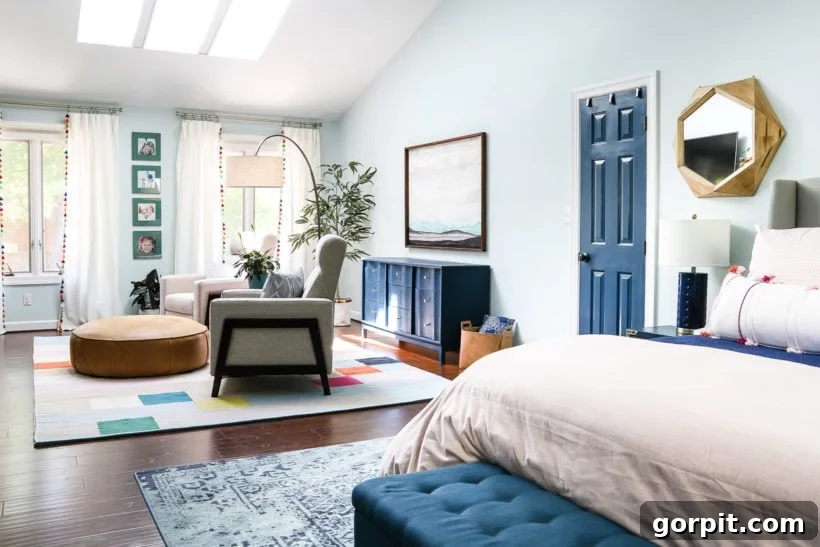
First and foremost, a bedroom rug acts as an essential anchor, effectively defining and grounding your sleeping space. In larger bedrooms, particularly those with distinct zones like a sitting area or a vanity, an area rug can literally delineate one functional space from another. For instance, in our colorful master suite in our old home, we used one area rug under the bed and another in the sitting area, creating clear, distinct zones within the room.
Beyond defining space, bedroom rugs significantly enhance comfort and coziness. If your bedroom features hard flooring, an area rug provides a much-needed layer of warmth and softness underfoot. Imagine stepping out of bed on a chilly morning onto a plush, inviting rug instead of a cold, hard floor – it makes a huge difference to your morning routine. This tactile comfort contributes greatly to the serene and inviting atmosphere every bedroom should possess.
Finally, never underestimate the profound design impact a rug can have. Area rugs are powerful tools for introducing color, texture, and pattern into a bedroom, adding depth and visual interest that can transform an otherwise plain space. This is precisely why we incorporate area rugs in both Avery’s bedroom and Attley’s bedroom, even though both rooms already have wall-to-wall carpeting. Yes, you read that right – area rugs can absolutely be layered over carpet to add an extra dimension of style and comfort!
Key Bedroom Rug Considerations
- The most common rug size for a king-sized bed is 9′ x 12′.
- The most common rug size for a queen-sized bed is 8′ x 10′.
- A bedroom area rug should extend at least 18 to 24-inches beyond the sides and the foot of any bed.
- The length of your bedroom rug should run perpendicular to your bed.
- Leave between 10″ and 24″ between your rug and bedroom walls.
Choosing the right rug size for a bedroom presents a unique challenge, distinct from selecting a rug for a living room. In the bedroom, your primary focus should be the dimensions of your bed and the overall size and layout of the room. However, it’s also crucial to account for any other furniture pieces present in the space, such as nightstands, benches, or dressers, to ensure a balanced and harmonious arrangement. While common guidelines exist, flexibility is key to achieving a truly functional and aesthetically pleasing result.
As a general rule of thumb, an area rug in a bedroom should extend a minimum of 18 to 24 inches beyond the sides and the foot of your bed. This generous overhang ensures that when you step out of bed, your feet land on the soft comfort of the rug, rather than the bare floor. For king-sized beds, the most frequently recommended rug size is 9′ x 12′, providing ample coverage. For queen-sized beds, an 8′ x 10′ rug is often the ideal choice. These sizes offer a good balance of coverage and proportion, but the ultimate decision will also depend on your room’s specific dimensions.
It’s important to remember that while a larger rug can create a luxurious feel, you don’t want it to stretch so far that it touches the bedroom walls. Maintaining a clear border, typically between 10 to 24 inches, between the rug and the walls, helps define the space and prevents the room from feeling cramped or overwhelmed by the rug. Additionally, and this might seem counterintuitive at first, the length of your bedroom rug should typically run perpendicular to your bed. This orientation maximizes the visual and tactile coverage where it’s most needed – along the sides and at the foot of the bed – creating a more inviting and cohesive look.
What Furniture Should Sit On Your Bedroom Rug?
The question of how to properly position a bedroom rug relative to your furniture is a topic that often sparks debate among design enthusiasts. There isn’t a single, universally accepted “rule” for rug placement; instead, it’s more helpful to think in terms of flexible “guidelines” and “options.” This adaptability is crucial because every bedroom possesses its own unique dimensions, layout, and furniture arrangement. What works perfectly in one space might not be the best solution for another. By understanding the various approaches to furniture placement on a bedroom rug, you can make an informed decision that best suits your room’s aesthetic and functional needs.
3 Options for Furniture Placement on a Bedroom Rug
There are 3 common options for furniture placement on a bedroom rug:
- Only your bed sits on your rug. In this setup, the rug is positioned so that only the bed frame and mattress rest upon it. Nightstands are typically placed off the rug, directly on the hard flooring or carpet. This option is ideal for smaller rooms where you want the comfort of a rug underfoot without overwhelming the space, or when you have particularly ornate nightstands that you wish to highlight. It provides a defined zone for the bed and still offers a soft landing when you get up.
- Your entire bed, nightstands, and any furniture at the end of your bed (e.g., a bench, armchairs) sit on your rug. This is the most expansive option, creating a luxurious and cohesive look. The rug extends significantly beyond all sides of the bed, allowing all bedside tables and foot-of-bed furniture to be fully placed on it. This works best in larger bedrooms where there’s ample space to accommodate a generously sized rug without it feeling cramped or wall-to-wall. It helps to unify the entire sleeping zone and creates a sense of grandeur.
- Only 2/3 to 3/4 of your bed and any furniture at the end of your bed (e.g., a bench, armchairs) sit on your rug. This is arguably the most common and versatile approach. The rug starts roughly two-thirds to three-quarters of the way down from the headboard, allowing the nightstands to remain off the rug. However, it extends far enough to fully accommodate any furniture at the foot of the bed and provides a comfortable landing strip on both sides. This option strikes a great balance, offering the visual appeal and comfort of a large rug without necessarily requiring the largest possible rug size, making it suitable for a wide range of bedroom dimensions.
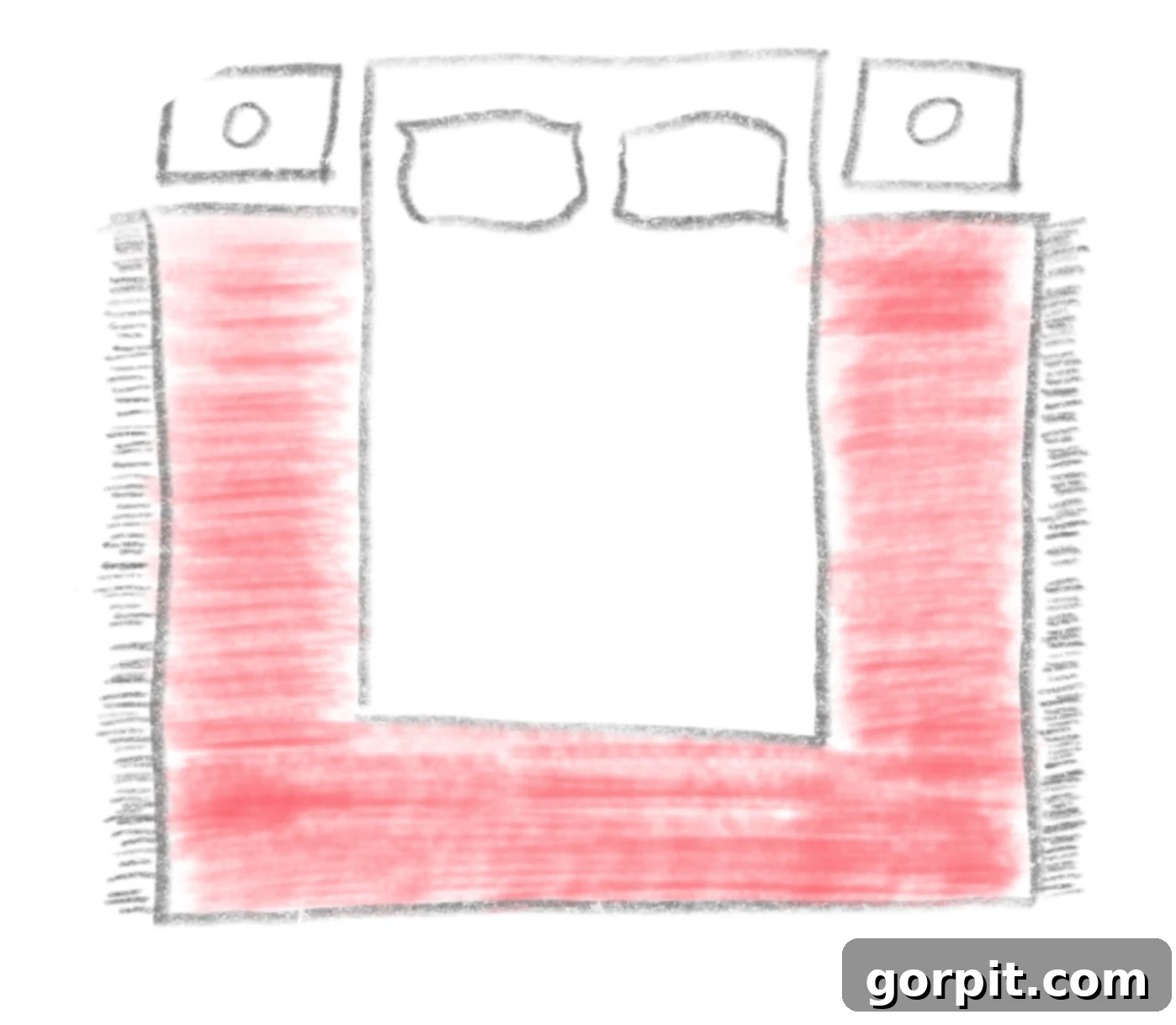
My preferred approach to bedroom rug sizing and placement, as illustrated in the sketch below, aligns most closely with the third option. In this typical setup, the rug is sufficiently large to extend under approximately three-quarters of the bed, ensuring a soft surface for your feet upon waking. Importantly, the nightstands are deliberately kept off the rug, allowing for easy access and stability. This placement also ensures that the rug extends at least 18 to 24 inches beyond the sides of the bed, providing ample comfort and visual balance. This method creates a defined and cozy sleeping area while maintaining practicality and a clean aesthetic.

What Size Rug Does My Bedroom Need?
Determining the “right” rug size for your bedroom is largely dependent on two key factors: the dimensions of your bed and the overall size of your room. While personal preference and furniture arrangement play a role, there are established guidelines that can help you create a harmonious and functional space. The most frequently chosen area rug sizes for bedrooms are 8′ x 10′, 9′ x 12′, and for very large rooms, 12′ x 18′. Specifically, an 8′ x 10′ rug is generally considered the most suitable size for a queen-sized bed, while a 9′ x 12′ rug is the go-to option for a king-sized bed.
It’s crucial to understand that with very few exceptions, a rug smaller than 8′ x 10′ – such as a 5′ x 8′ or 5′ x 7′ rug – is typically too small for a bedroom setting, especially when placed under a bed. These smaller rugs tend to look dwarfed by the bed, failing to provide the expansive comfort and grounding effect that larger rugs offer. They often make the room feel disconnected and less luxurious. Always aim for a rug that can generously frame your bed and extend comfortably beyond it, creating a soft, warm landing for your feet when you start and end your day.
What Size Rug for a King Bed?
When selecting a rug for a king-size bed, which typically measures 76 inches wide by 80 inches long, or a California king-size bed (72 inches wide by 84 inches long), the minimum recommended rug size is 9′ x 12′. This size ensures that the rug extends sufficiently beyond the sides and foot of the bed, providing adequate coverage and visual balance. A 9′ x 12′ rug allows for the bed to be properly centered, with enough rug exposed to comfortably step onto from either side.
If your bedroom is particularly spacious and your budget allows, opting for an even larger rug, such as a 10′ x 14′ or even a 12′ x 15′, can create an even more luxurious and grounded feel. This is especially true if you plan to include additional furniture, like a bench or seating area, at the foot of your bed that you wish to have on the rug. Resist the temptation to use an 8′ x 10′ rug under a king bed; it invariably looks disproportionately small, making the bed appear to overwhelm the space and the rug itself feel inadequate.
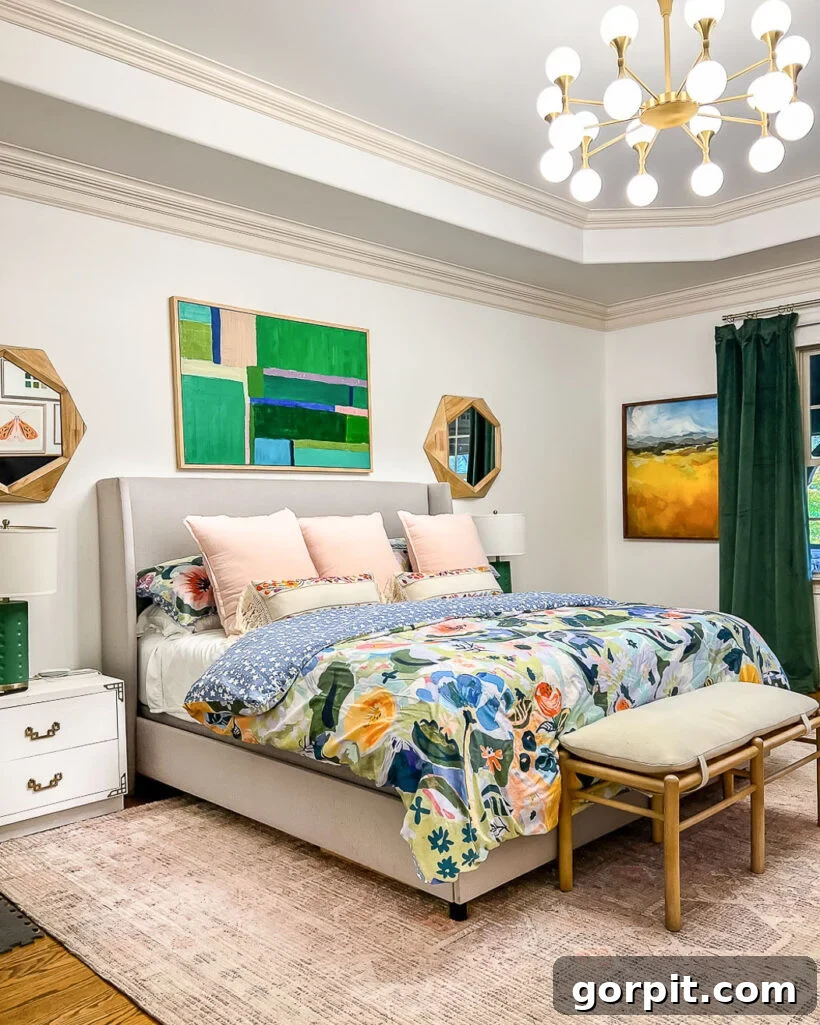
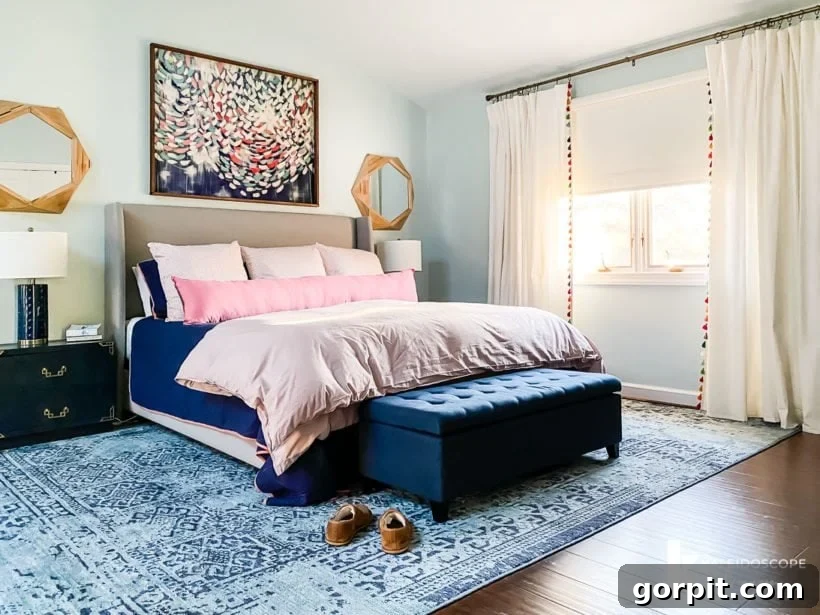
In our current bedroom, for example, we have successfully utilized a 9′ x 12′ rug beneath our king-size bed. This placement allows the rug to reach just up to the bedside tables, with the tables themselves remaining off the rug. The generous size of the rug comfortably accommodates about three-quarters of our bed, along with a bench positioned at the foot, and still extends a substantial 18 to 24 inches beyond the bench. This configuration provides both aesthetic appeal and practical comfort.
In our previous home’s colorful master bedroom, we also chose a 9′ x 12′ rug for our king-size bed. However, in that particular layout, we opted for a different furniture placement strategy, ensuring that both our entire bed and the accompanying nightstands rested completely on the rug. This showcases the flexibility of rug placement based on room size, furniture scale, and desired aesthetic.
What Size Rug for a Queen Bed?
For a queen-size bed, which measures 60 inches wide by 80 inches long, an 8′ x 10′ area rug is the most commonly recommended and versatile choice. This size provides excellent coverage, extending sufficiently beyond the sides and foot of the bed to ensure a soft landing for your feet. It creates a well-defined sleeping zone and adds a luxurious feel to the room.
While an 8′ x 10′ rug is generally ideal, my personal preference, as with king beds, leans towards a slightly larger rug if your room’s dimensions and budget can comfortably accommodate it. For instance, a 9′ x 12′ rug could offer even more expansive coverage, especially if you have a larger queen bedroom or want to include a bench at the foot of the bed fully on the rug. However, for most standard queen bedrooms, the 8′ x 10′ strikes a perfect balance.
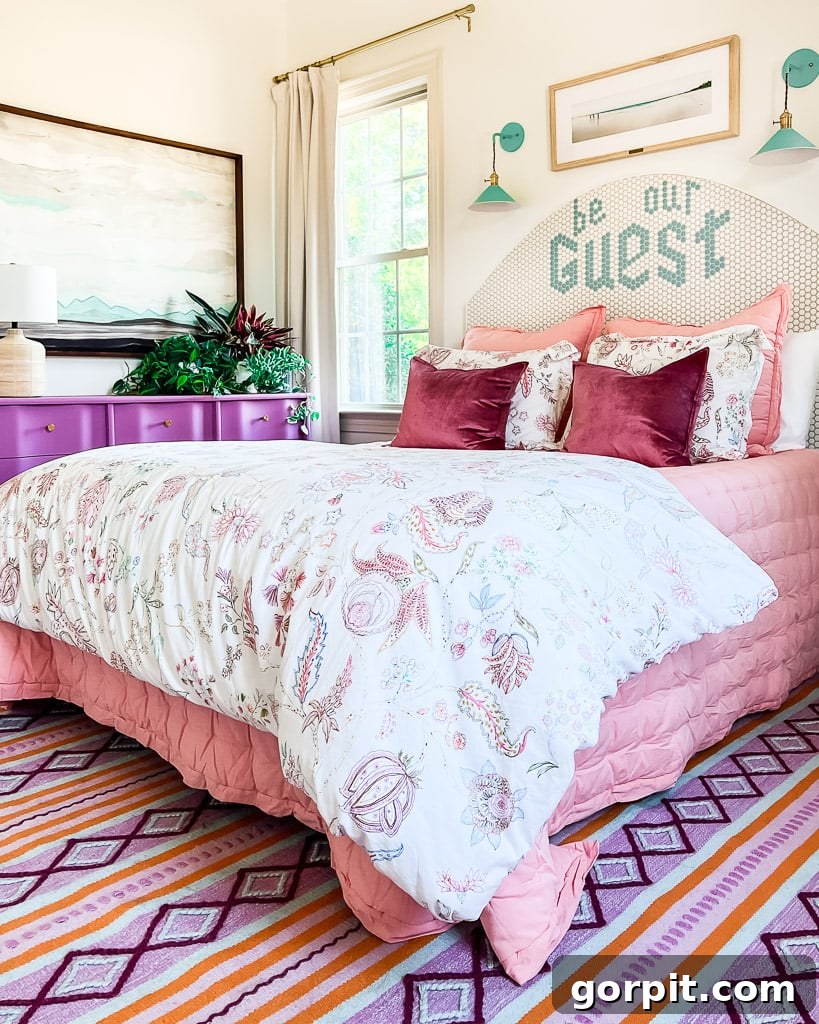
In our colorful guest room, we opted for an 8′ x 10′ rug under the queen-size bed. This decision was largely influenced by the room’s relatively modest size; a larger rug would have made the space feel cramped and disproportionate. Despite the room’s dimensions, the 8′ x 10′ rug still offers ample extension on each side and at the foot of the bed, proving that even in smaller spaces, generous rug coverage is achievable and impactful.
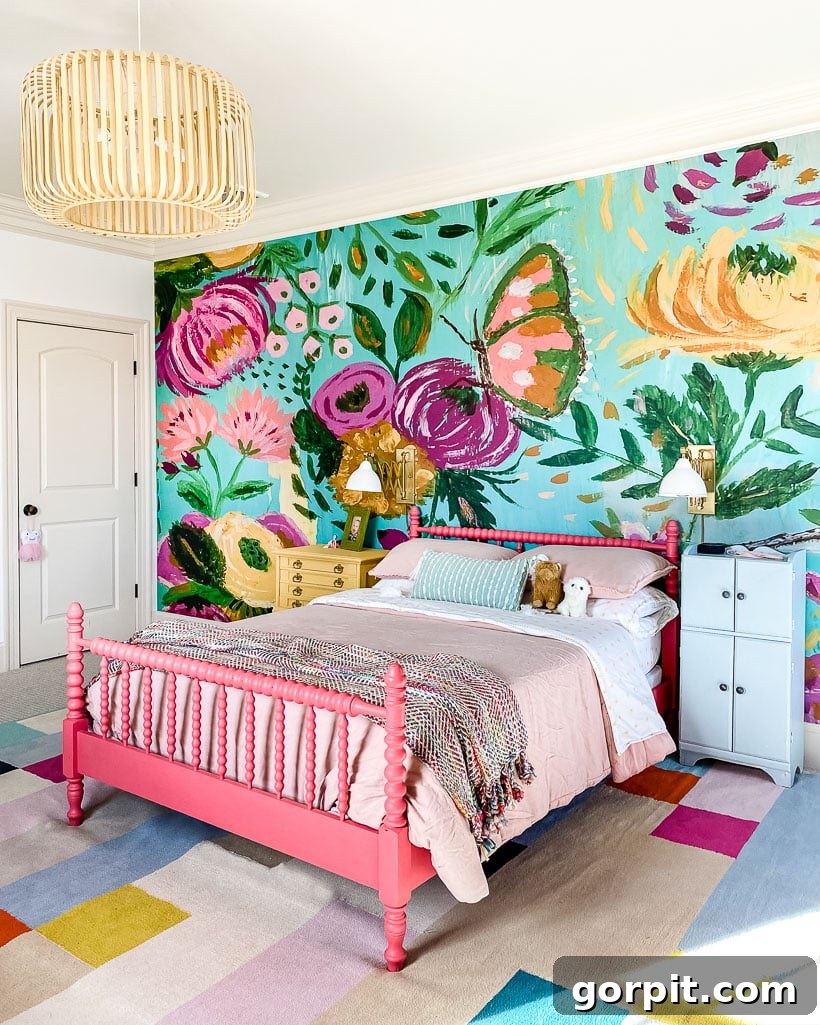
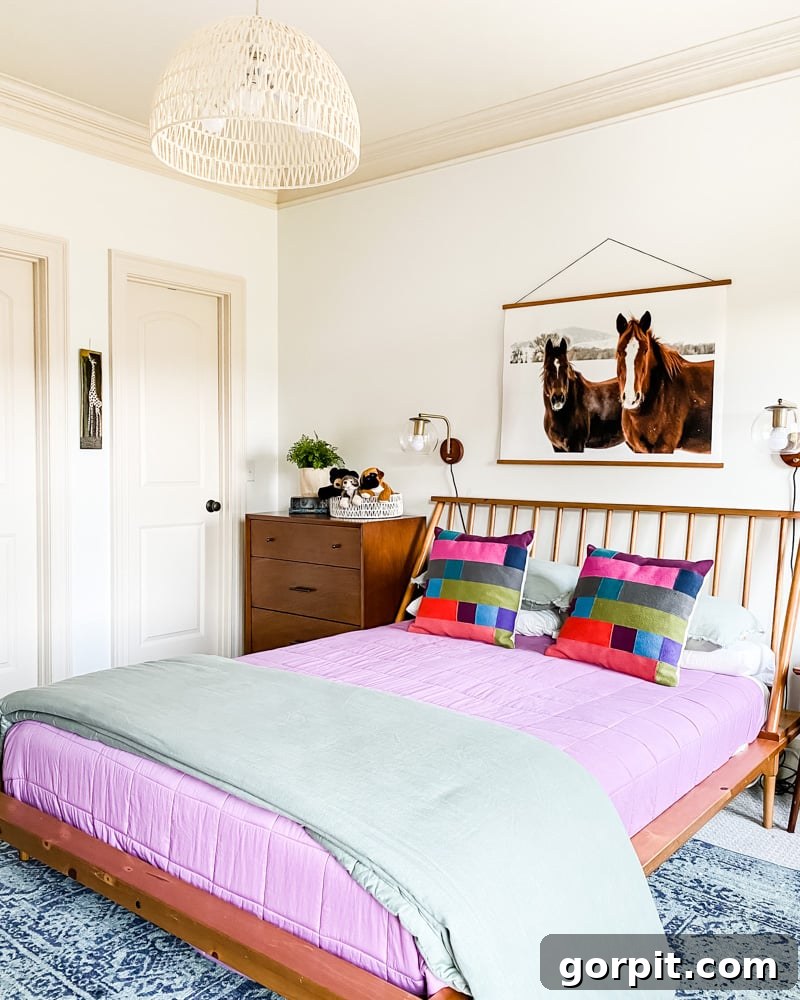
We’ve also used an 8′ x 10′ area rug under the queen-size bed in our daughter Avery’s bedroom. An important design note here: her area rug is placed directly on top of existing wall-to-wall carpet. This illustrates that having carpeting doesn’t negate the need for an area rug in a bedroom. Area rugs are too vital for enhancing the design, comfort, and defined zoning of a space to be skipped simply because there’s already wall-to-wall carpeting.
What Size Rug for a Full Bed?
A full-size bed measures 54 inches wide by 75 inches long, making it slightly smaller than a queen bed. Despite its smaller dimensions, for the purpose of choosing an area rug, it’s generally best to treat a full-size bed similarly to a queen-size bed. This means aiming for an 8′ x 10′ rug as your standard choice.
This recommendation stems from the desire to achieve proper scale and ensure adequate rug coverage around the bed. A smaller rug, such as a 5′ x 7′ or 6′ x 9′, would likely look too small and fail to provide the comfortable expanse underfoot that is so desirable in a bedroom. The goal is to have enough rug extending beyond the sides and foot of the bed to create a cozy and well-defined sleeping area. Therefore, an 8′ x 10′ rug allows for that generous border and creates a more luxurious and grounded feel for a full-size bed.
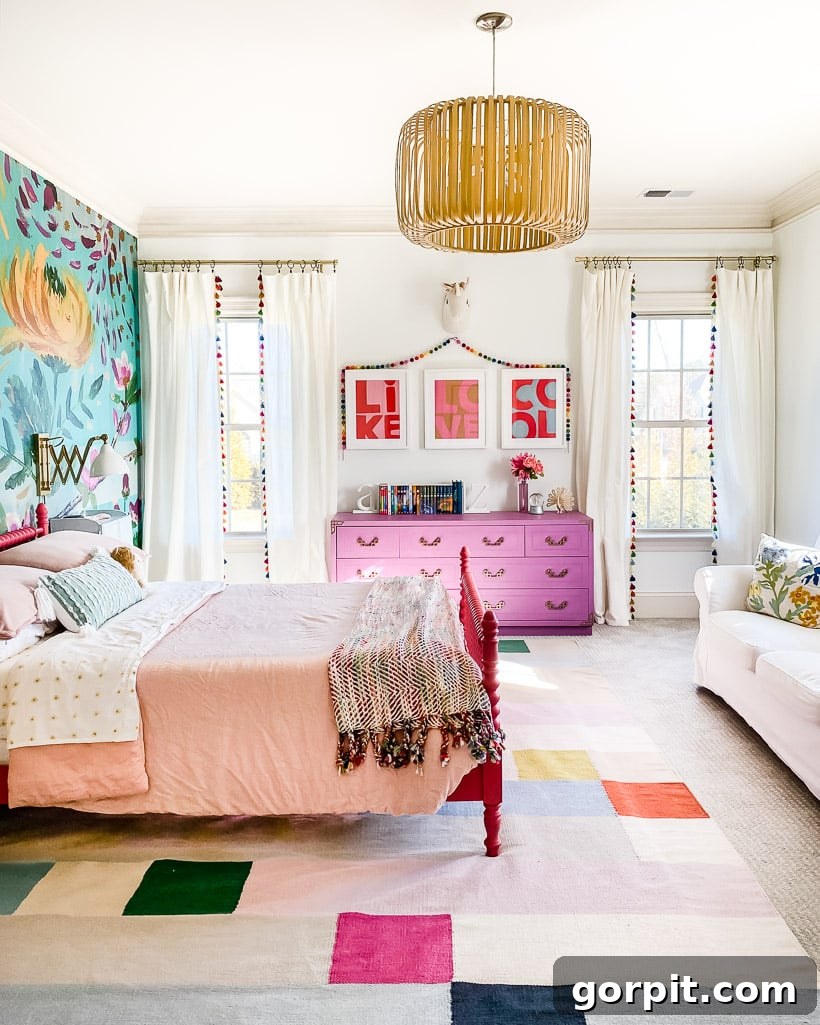
Remember my earlier advice to opt for a larger rug if your budget and room size permit? We put this principle into practice in our daughter Attley’s room. Although her charming vintage Jenny Lind bed is only a full-size, her bedroom is exceptionally spacious. A smaller rug would have looked lost and disproportionate within the expansive room. By choosing a larger rug, specifically a 9′ x 12′, we achieved a much better visual balance and a more grounded, luxurious feel for her sleeping area. (As a side note, this is the same beautiful rug that previously graced the sitting area of our master bedroom in our old home, demonstrating the versatility of quality rugs).
What Size Rug for Twin Bed(s)?
Choosing the correct rug size for twin beds can vary significantly depending on the room’s layout and whether you have one or multiple twin beds. A standard twin bed measures 38 inches wide by 75 inches long, offering several rug placement possibilities.
For a single twin bed, particularly one placed against a wall, you can typically “get away with” a 5′ x 7′ or 6′ x 9′ rug. The 5′ x 7′ would allow the rug to extend comfortably from the side of the bed where you step out, and past the foot of the bed. A 6′ x 9′ rug would offer even more coverage, providing a more luxurious feel and a wider soft landing zone.
If you have two twin beds placed parallel to each other, such as in a shared kids’ room or a guest room, there are a couple of approaches. You could use a 5′ x 7′ or 6′ x 9′ rug positioned in between the two beds. This creates a soft walkway and a central anchor for the room. However, a more cohesive and often more aesthetically pleasing option is to use one larger rug that both twin beds can sit on. For instance, a 9′ x 12′ or even an 8′ x 10′ rug could work well to encompass both beds and any nightstand placed between them, creating a unified sleeping area. This option grounds the entire zone and enhances the overall comfort and design of the room. Always consider the room’s total size and the traffic patterns when making your final decision.
You now have all the essential insights and practical guidance needed to confidently choose your next bedroom rug! No more stressing over the perfect size or agonizing about how your furniture should be arranged. Armed with these tips, you’re ready to create a bedroom that is not only stylish but also wonderfully comfortable and inviting.
Where Can I Buy an Affordable Rug for My Bedroom?
Finding a beautiful area rug for your bedroom doesn’t have to break the bank. There are numerous retailers known for offering high-quality rugs at accessible price points. To help you on your quest, I’ve curated some fantastic options based on typical 8′ x 10′ sizes, categorized by price range. Please note that prices are subject to change and often fluctuate with sales, so if you spot a rug you love that’s currently above its listed category price, keep an eye on it—it might go on sale soon! Many online retailers frequently offer promotions, especially around holidays.
For insider tips and real-time updates on rug sales, be sure to follow me on Like to Know It, where I regularly share my favorite finds and sales. And remember, a great rug deserves an equally great rug pad! If you need guidance on selecting the perfect one, check out my comprehensive rug pad guide for all the details.
Large Rugs Under $300
This section would typically feature a curated selection of affordable 8’x10′ rugs available for under $300. Look for options from popular online retailers like Rugs USA, Wayfair, Target, and Overstock, which often carry stylish synthetic or cotton blend rugs at competitive prices. Keep an eye out for sales and seasonal promotions to maximize savings.
[Product listings for large rugs under $300 go here]
Large Rugs Under $500
In this category, you can expect to find a broader range of styles and materials, still offering excellent value. Retailers like boutique rug stores online, larger home goods chains, and even some department stores expand their selections here. You might find more intricate patterns, slightly denser pile heights, or blends with natural fibers. Click on any rug below for full product details.
[Product listings for large rugs under $500 go here]
Large Rugs Under $600
Stepping into the under $600 category, you’ll discover even more premium options, often including wool blends, hand-tufted designs, or more unique patterns and textures. These rugs offer increased durability and a more luxurious feel. Explore collections from specialized rug retailers and higher-end home decor stores during their sale events. Click on any rug below for full product details.
[Product listings for large rugs under $600 go here]
More RUG Posts
SEE ALL rug POSTS
-
Designer Tips for Choosing Perfect Kitchen Rug Runners
-
How to Choose the Best Rug Size for Your Living Room
-
How to Install a Stair Runner: A Step-by-Step Tutorial
-
How to Keep Rug Corners Down – Tips and Tricks for Every Homeowner
-
The Best Places to Shop for Affordable Rugs
-
The Rug Pad Guide: What You Need to Know Before You Buy
Be sure to save this post for future reference, so you can revisit these guidelines whenever you’re ready to refresh your bedroom decor or embark on a new rug-finding adventure!
Other posts you may enjoy:
- How to Make a Small Room Look Bigger: 9 Simple Tricks
- Best Sofa Options for Every Color and Budget
- How to Choose Paint Colors for Your Home: 6 Simple Tips to Follow
- 8 Interior Design Mistakes You Don’t Even Know You are Making (and How to Fix Them)
- How to Make a Mood Board: A Step-by-Step Guide
Curious about my approach to transforming rooms and spaces in our home? Dive into the details with Designer in a Binder® – your affordable and simple guide to decorating with confidence.
For exclusive content, behind-the-scenes sneak peeks, and fresh design inspiration delivered straight to your inbox, be sure to subscribe before you go!
[Subscription Form Placeholder]